First-Principles Leadership and AI

Rethinking From the Ground Up: How First Principles and AI Are Redefining Strategy and Leadership
Across industries—mobility, finance, energy, healthcare, manufacturing, retail, and the public sector—a fundamental shift is underway. McKinsey’s recent analysis shows how disruptors are outperforming incumbents through radically new “Innovation Execution” models. But beneath these surface differences lies a deeper transformation:
AI is enabling leaders to return to first principles and redesign products, processes, and business models from scratch.
This marks a break from the optimisation logic that governed the last several decades.
It signals a new paradigm built on architectural reinvention, not refinement.
From Optimising the Old to Designing the New

Lean, Six Sigma, and continuous improvement helped companies refine what already existed.
But those systems are increasingly unable to meet today’s competitive thresholds.
Disruptors—especially in fast-moving sectors such as EVs, electronics, and energy—are showing what becomes possible when AI and first-principles thinking converge:
- System-level redesign instead of incremental upgrades
- Integrated software–hardware–data architectures
- Cycle times cut by 50–70%
- Gigafactories built in 16 months instead of 58
- Cost/performance curves far outpacing incumbents
- Outcome-based business models powered by real-time intelligence
These are not small improvements.
They represent new performance frontiers.
A Brief Origin of First-Principles Thinking

The idea of first principles has deep roots. It began with Aristotle, who described first principles (archai) as the fundamental truths that cannot be reduced further — the foundations from which all understanding must begin.
Centuries later, the scientific revolution revived this approach: thinkers like Galileo and Newton broke complex phenomena into elemental physical laws, enabling breakthroughs that reshaped modern science.
In the 20th century, engineers adopted first-principles reasoning to design aircraft, materials, and systems from basic constraints rather than tradition. More recently, innovators such as Elon Musk and Jeff Bezos reintroduced the concept into business, using it to challenge industry assumptions and build entirely new architectures.
Today, AI finally enables first-principles thinking at scale.
Simulation, digital twins, machine learning, and generative design make it possible for organisations to strip problems down to their essentials — and explore radically new solutions — faster, safer, and cheaper than ever before.
What began as philosophy has now become one of the most powerful strategic tools available to leaders.
How AI Supports First-Principles Innovation

AI is not just an accelerator—it is what makes first-principles redesign possible at scale.
It helps organisations break down complexity, challenge convention, and explore radically better solutions.
1. AI helps deconstruct complexity
Simulation, digital twins, and modelling reveal the essential elements of a system. Examples:
- Automotive: AI optimises vehicle bodies, enabling gigacasting that replaces hundreds of welds.
- Healthcare: Digital twins model patient flows to redesign care from scratch.
- Energy: AI simulates renewable grid behaviour to re-architect infrastructure.
2. AI helps reveal hidden constraints and outdated assumptions
Machine learning shows what actually drives cost, quality, and performance—and what constraints are simply legacy. Examples:
- Insurance: ML identifies true risk drivers, resetting outdated underwriting rules.
- Manufacturing: AI reveals which tolerances matter, eliminating unnecessary steps.
- Finance: AI uncovers which compliance processes add value and which can be redesigned.
3. AI helps generate new solution pathways
Generative AI proposes architectures, materials, workflows, and business models leaders might never imagine. Examples:
- Product design: AI discovers lighter, stronger geometries for components.
- Service design: AI removes 40–60% of process steps in customer journeys.
- Public sector: AI reimagines service flows to improve outcomes and reduce friction.
4. AI helps accelerate low-risk experimentation
Virtual testing enables rapid exploration of hundreds of options before investing. Examples:
- Pharma: AI tests molecule combinations virtually before lab trials.
- Retail: AI evaluates assortment and pricing scenarios in minutes.
- Infrastructure: Digital replicas allow redesign without operational disruption.
Across sectors, AI makes it cheaper, faster, and safer to redesign than to optimise.
Why Many Organisations Struggle

McKinsey highlights three recurring barriers:
1. Legacy architectures. Systems built for a world that no longer exists.
2. A culture of optimisation. Decades of efficiency thinking reward predictability—not exploration.
3. Governance built for stability, not redesign. Boards often default to control rather than enabling architectural innovation.
These barriers are structural—but they are also deeply human.
Most leaders were trained to protect what works, not imagine what could be.
The Human Shift: What Leadership Must Look Like Now

AI-enabled redesign requires new human and leadership capabilities:
- Curiosity over certainty
- Systems thinking over silos
- Rapid learning over perfect planning
- Psychological safety to question norms
- Leaders who orchestrate collaboration rather than control it
- Teams equipped with data, AI tools, and autonomy
AI does not replace people.
It amplifies those who can think across boundaries and redesign systems from first principles.
What Boards and Executives Need to Do Now

To lead in an era shaped by AI and first-principles redesign, boards and executives must shift from managing the existing system to enabling the emergence of a new one. Six strategic actions matter most:
1. Build conviction about what AI-enabled redesign makes possible. Understand the new cost curves, performance frontiers, and architectural options AI unlocks.
2. Ask first-principles questions at the top. What would we build if we started from zero? What constraints are real versus inherited?
3. Set ambition levels that force new thinking. Targets should be bold enough that old systems cannot meet them.
4. Enable rapid, low-risk experimentation. Give teams access to simulation, digital twins, generative design, and AI-driven testing.
5. Align culture, talent, and incentives for exploration. Encourage cross-functional collaboration, curiosity, and intelligent risk-taking—not just efficiency.
6. Provide responsible guardrails for AI-driven redesign. Set principles for safety, transparency, ethics, and sustainability.
Boards must create the permission space for bold redesign—supported by governance that ensures it is responsible.
The Leadership Frontier Ahead

Competitive advantage now depends on the ability to rethink fundamentals:
- How value is created
- What products and services truly are
- How humans and AI collaborate
- How systems and architectures evolve
- How decisions are made
- How organisations learn
Leaders who thrive will combine AI-enabled imagination with first-principles clarity—and build organisations designed for redesign, not refinement.
Those who embrace this shift early—technologically, culturally, and in governance—will define the next decade.
Join Us for the Book Launch: AI Leadership for Corporate Boards
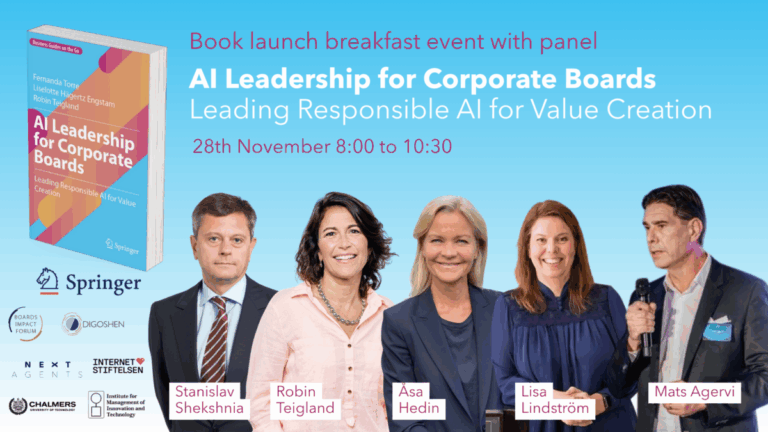
For leaders and board directors who want to go deeper into these themes, we warmly welcome you to the official launch of our book:
AI Leadership for Corporate Boards – Leading Responsible AI for Value Creation
Date: 28 November
Format: Breakfast event and panel
Host: Boards Impact Forum
Location: Internetstiftelsen, Stockholm
Presenters:
– Fernanda Torre
– Liselotte Engstam
– Robin Teigland
– Keynote guest: Stanislav Shekshnia
Panelists:
– Åsa Hedin (Chair, Qbtech, Nolato, Decon and Swedish Tennis Association; Board member, Industrifonden)
– Lisa Lindström (Business Reinvention Leader, EY; founder Doberman; board roles UR, Avanza, Nobel Media)
– Mats Agervi (CEO, Combient; Chair, Stram Analyze; Board member, Collegial)
It will be an energising morning with research insights, lived experience, panel reflections, and space for meaningful discussion.
A warm welcome to join us.
Full details: Boards Impact Forum — AI Leadership for Boards: Book Launch & Breakfast Panel – 28 November
References
McKinsey & Company (2025). Innovation Execution: A New Industrial Paradigm Emerges.
Analysis of disruptor performance, cycle-time compression, and integrated innovation–industrialisation models.
Engstam, Liselotte; Torre, Fernanda; Teigland, Robin; & Shekshnia, Stanislav (2025). AI Leadership for Corporate Boards – Leading Responsible AI for Value Creation. Springer Nature.
Frameworks include:
– Boards 4AI Leadership Matrix
– AI Leadership House
– AI governance, strategy, talent, and culture integration.
Engstam, Liselotte; Forzelius, Henrik; Magnusson, Mats; Torre, Fernanda; & Van der Heyden, Ludo (2024).
Dynamic Board Capabilities: Developing board practices that impact corporate renewal and performance.
Journal of Risk Management in Financial Institutions, 17(2), 142–160.
MIT CISR (2023–2025). Research on AI-enabled performance gaps, showing that firms integrating AI into strategy outperform those stuck in experimentation mode. Example research
Previous Related Blogposts
About Liselotte Engstam, Digoshen & Novisali
Liselotte Engstam is an explorer of perspectives, an adventurer of ideas, a pathfinder of meaning, and a guide of timeless transitions. She bridges the worlds of board leadership and art, helping organizations and individuals navigate disruption while nurturing creativity and reflection.
As founder of Digoshen, she works with boards and leaders to expand future insights and reduce digital and sustainability blindspots. Through research, networks, and executive programs, Digoshen supports responsible value creation in the digital and sustainable age, contributing thought leadership via books, articles, events, Digoshen Exploring Leaders podcast, and blogs.
She also serves as Chair of the Boards Impact Forum in collaboration with the World Economic Forum and the Climate Governance. The Forum convenes board members, thought leaders, and experts in dialogues, webinars, and collaborative events, accelerating action on climate, AI, and sustainability.
Through her artistic practice as Novisali, Liselotte explores creativity and meaning. Her watercolors, digitally reimagined, invite reflection and renewal, offering perspectives that connect head, heart, and hand, and complementing her work with leaders and boards.
→ Discover more at www.Digoshen.com
→ Learn more at www.BoardsImpactForum.com
→ Find more about Liselotte at www.liselotteengstam.com and her Google Scholar page
→ Explore Liselotte’s art and reflections at www.novisali.com and follow on Instagram @novisali_arts