Artwork – People
This page shows Artwork with People. Looking at Artwork while reflecting is a learning and meditative experience. If you like to know more about the positive benefits of looking at Artwork in a guided and reflective way, read more about it >> here
Guided reflection of Artwork with People
- Select a painting below you like to explore, they all show paintings of people.
- Start one of the audio guides, in English or in Swedish.
- Scroll down to the painting and let the Audio guide facilitate the reflection of the painting.
Mina Carlson-Bredberg
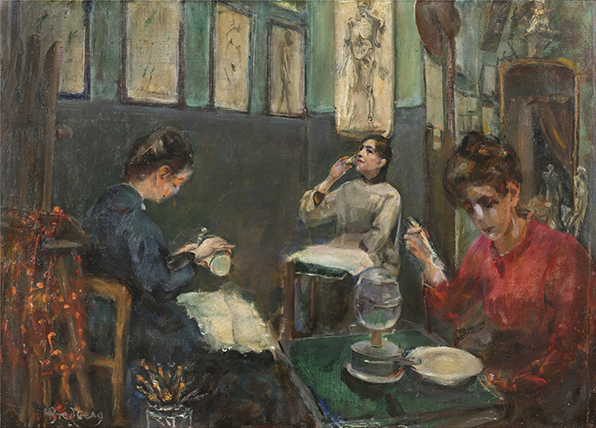
Académie Julian, Mademoiselle Beson Drinking from a Glass (circa 1884, by Mina Carlson-Bredberg). Courtesy of the Dorsia Hotel, Gothenburg, Sweden/the American Federation of Arts.
Mina Carlson-Bredberg (1847-1953) was a Swedish painter and began her artistic training with two Swedish artists, Kerstin Cardon and Amanda Sidwall. She later moved to Paris and attended the Académie Julian from 1883 to 1887.
Carlson-Bredberg excelled at many genres of painting, from landscape to interiors to floral still lifes and religious scenes. She exhibited a number of portraits at the Salons of 1887 and 1890 and received honorable mention for a self-portrait at the 1889 Exhibition Universelle. In 1890 she returned to Stockholm and taught at the art school established by Elizabeth Keyser, a friend and classmate at the Académie Julian.
When she was 20, Carlson-Bredberg’s family spotted her kissing a man, and the two were forced to marry, a union that lasted seven years and kept her from her art. She remarried in 1895, and again, her husband didn’t approve of her art career. She is said to have warned her nieces “Girls, remember to think how lucky you are not to be married!”
Albert Edelfelt

Good Friends (portrait of the Artist’s Sister, Bertha Edelfelt, circa 1881, by Albert Edelfelt). Courtesy of the Hopkins Collection.
Albert Edelfelt (1854-1905) was a Finnish-Swedish painter whose works brought the culture and life of Finland to audiences abroad. His architect father’s salary made it possible for Edelfelt to study art professionally. He began his student life in Finland, then went to Antwerp, Paris and finally to St Petersburg. He met several prominent artists along the way who influenced his work.
He was the first Finnish artist to achieve international success. He painted many portraits including of Louis Pasteur and the royal family of Russia. He founded the realist movement in Finland and influenced numerous other, younger artists in his home country. His paintings are often filled with light, and are meticulously well-composed. His brushwork is varied, some pieces showing flourishing, loose brushstrokes and some being much more densely painted.
Said to be something of a lothario, with his dark good looks and his bristling, fashionable moustaches, he married a Baroness but continued with his romantic liaisons nevertheless.
Helen Thesleff
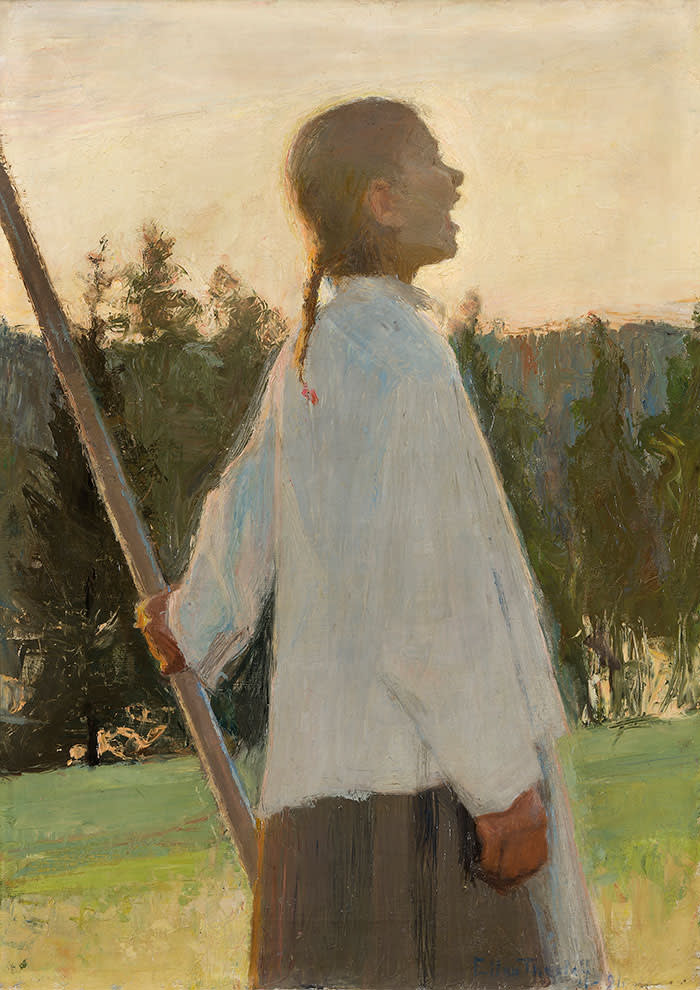
Echo, circa 1891 by Helen Thesleff. Courtesy of the American Federation of Arts, Anders Wiklöf Collection Andersudde, Åland Islands. Photo by Kjell Söderlund.
Ellen Thesleff was born in Helsinki and studied at a private Finnish painting academy beginning at age 16, before transferring to the Finnish Art Society Drawing School. As a young woman, Thesleff was influenced by Symbolism. After moving to Paris in 1891 to study at the Académie Colarossi, she helped formed Finland’s Septem group, which brought Impressionism to the Nordic country. Her painting Echo was a hit at the Finnish Art Society’s 1891 exhibition, called a “breakthrough” by the critics. Traveling frequently, Thesleff exhibited internationally, in Florence, Paris, Stocklhom, and St. Petersburg. She won a bronze medal at the 1900 Exposition Universelle in Paris.
Thesleff was named an honorary member of the Artists Society of Findland and was awarded the Pro Finlandia medal by the Finnnish president in 1951, but has received little posthumous recognition, aside from a 1998 exhibition at the Helsinki Ateneum.
Edward Munch
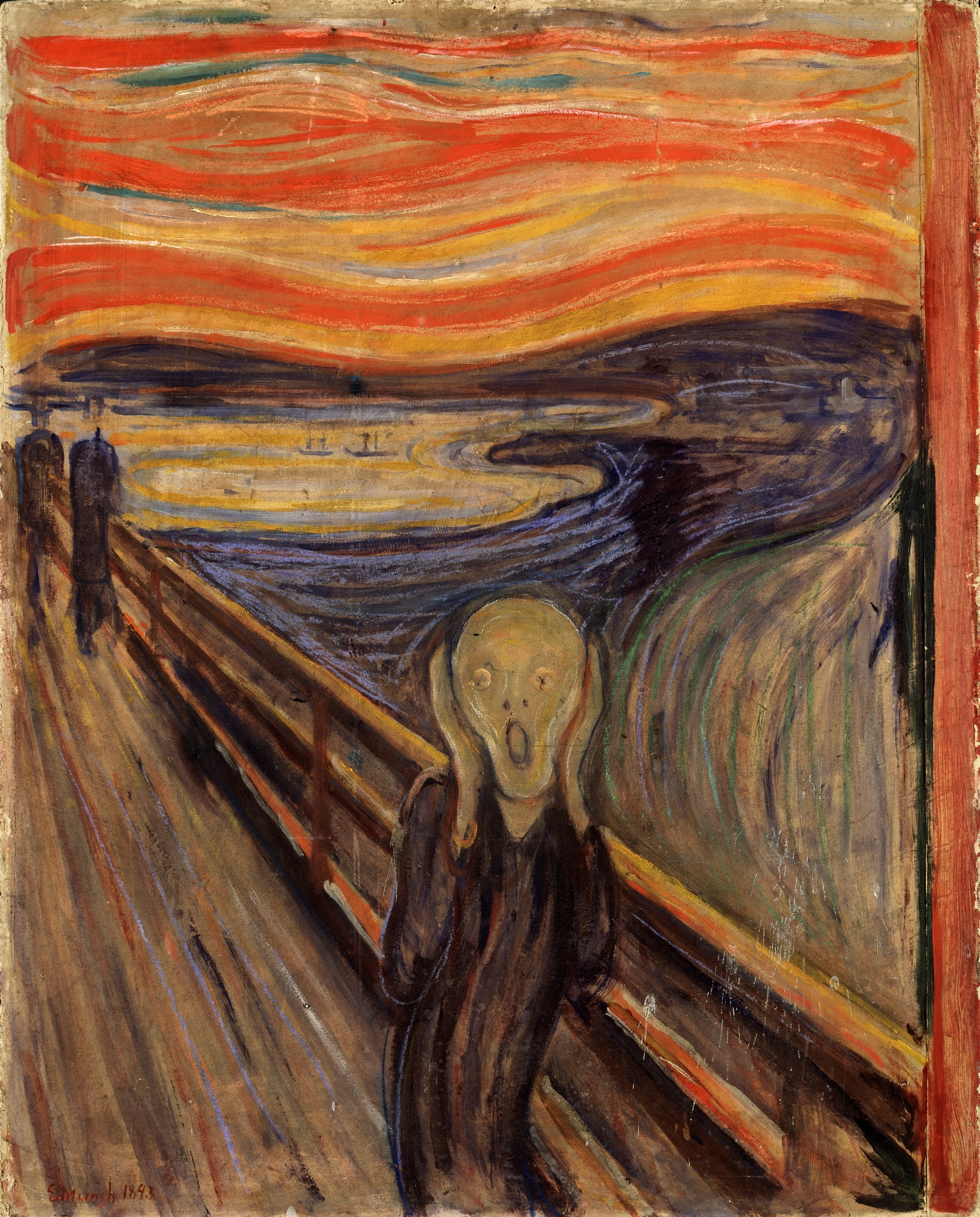
The Scream, circa 1893 by Edward Munch . Courtesy of Munch Museum Oslo.
Edvard Munch was a Norwegian painter. His childhood was overshadowed by illness, bereavement and the dread of inheriting a mental condition that ran in the family. Studying at the Royal School of Art & Design in Kristianina (today Oslo), Munch began to live a bohemian life under the influence of nihilist Hans Jaeger, who urged him to paint his own emotional and psychological state (‘soul painting’). From this emerged his distinctive style.
Travel brought new influences and outlets. In Paris, he learned much from Paul Gaugin, Vincent Van Gogh and Henri de Toulouse-Lautrec, especially their use of colour. In Berlin, he met Swedish dramatist August Strindberg, whom he painted, as he embarked on his major canon The Frieze of Life, depicting a series of deeply-felt themes such as love, anxiety, jealousy and betrayal, steeped in atmosphere.
The Scream was conceived in Kristiania. According to Munch, he was out walking at sunset, when he ‘heard the enormous, infinite scream of nature’. The painting’s agonised face is widely identified with the angst of the modern person. Between 1893 and 1910, he made two painted versions and two in pastels, as well as a number of prints. One of the pastels would eventually command the fourth highest nominal price paid for a painting at auction.
As his fame and wealth grew, his emotional state remained insecure. He briefly considered marriage, but could not commit himself. A breakdown in 1908 forced him to give up heavy drinking, and he was cheered by his increasing acceptance by the people of Kristiania and exposure in the city’s museums. His later years were spent working in peace and privacy. Although his works were banned in Nazi Germany, most of them survived World War II, securing him a legacy. Many sources agree that Munch’s work is the beginning of the expressionist movement that spread through Germany and on to other parts of the world. The Scream is very often seen an icon of modern art, a Mona Lisa for our time.
Michael Ancher
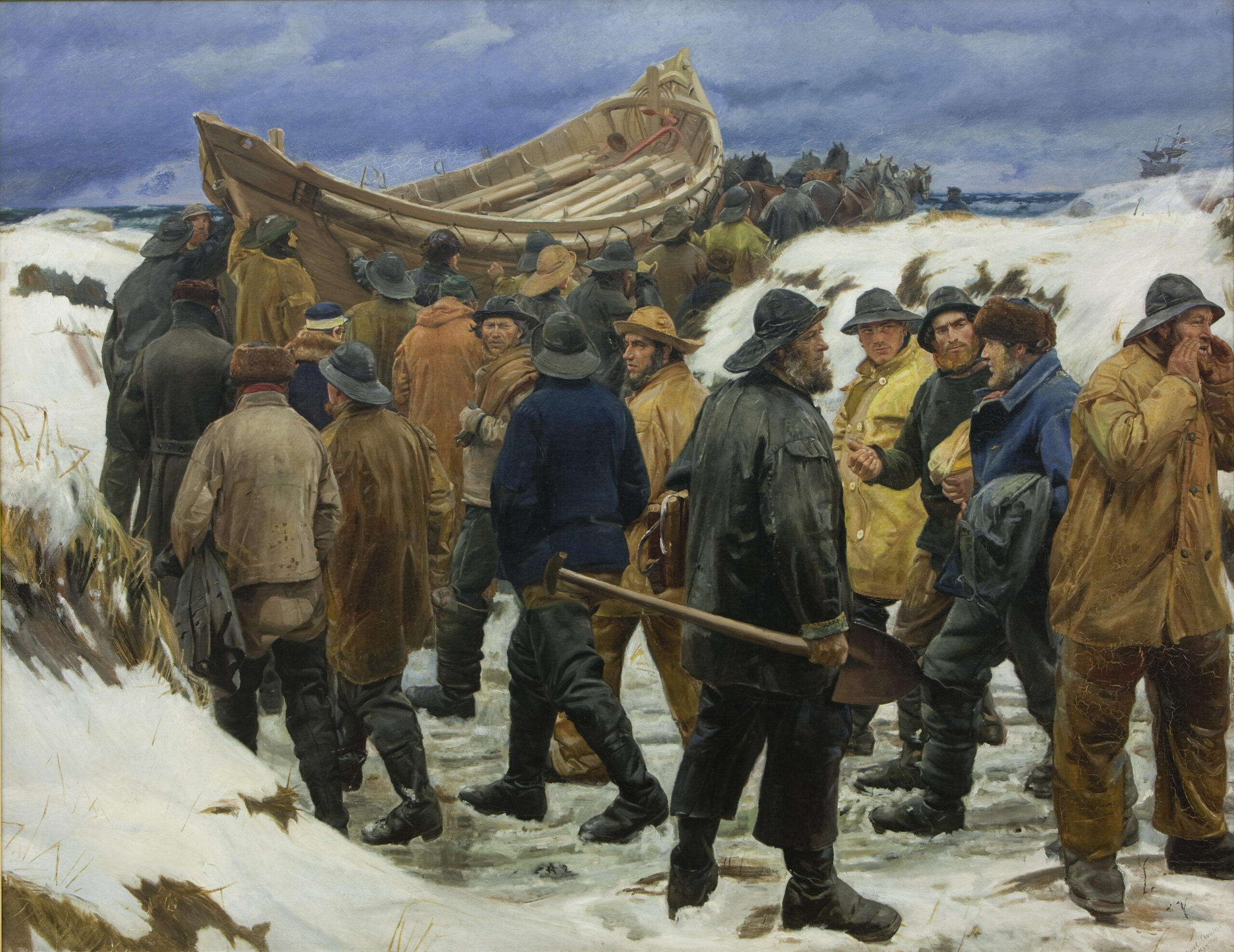
The lifeboat is taken through the dunes, 1883 by Michael Peter Ancher. Courtesy Statens Museum for Kunst in Denmark.
Michael Ancher was a Danish artist and came to Skagen in 1874 at the age of 25, and he was the only one of the visiting artists who settled permanently in the town. He grew up on the island of Bornholm, and at the age of 16, he began his apprenticeship as a clerk at the Kalø Manor in Djursland.
Here, he began to draw and paint in his spare time, and in 1871 he was accepted as a student at the Royal Danish Academy of Fine Arts in Copenhagen. Here, he met Karl Madsen, among others, who encouraged him to go to Skagen.
Michael Ancher is known for his portrayals of Skagen’s heroic fishermen and for his dramatic paintings of the fishermen’s work at sea. In his large figure paintings he combines the classic compositional principles of historic paintings with a fascinating realism. In the early 20th century, Michael Ancher took an active part in the founding of Skagens Museum, but he died in 1927, the year before its official opening.
In 1877, he was engaged to Anna Brøndum, and they married in 1880. After the birth of their daughter Helga in 1883, the family moved to Markvej in Skagen.
Courtesy and idea thanks to “Look at Paintings“, where more international painters can be found for reflection.